

Do Illegal Immigrants Commit More Crime Than Citizens?
What a viral article gets right, and what it gets wrong, about the accepted narrative on crime and immigration.


A piece by Alexander Muse - a Twitter user with over ½ million followers - was making the rounds a few months back. Its thesis is so mouth-watering to immigration skeptics, I’ll be surprised if its conclusions don’t ultimately become received wisdom on the right:
Immigrants commit more crime, actually.
I read the piece carefully, and while it’s interesting, I would advise taking its conclusions with a grain of salt. The author does not fully succeed in substantiating his strong claim. It’s an thoughtful, probably overdue piece, and I don’t want to be hard on it, but its thesis is overstated.
At best - and this is a big deal in its own right - the piece shows that the accepted claim about immigrant non-criminality is less supportable than people think.
The Left’s Claim Gospel
“Illegal immigrants commit less crime than the overall population,” is an article of faith on the left. As Muse correctly states,
The claim is treated as a conversation stopper. Once uttered, it is meant to end inquiry. If the data show lower rates, then immigration enforcement is unnecessary, even unjust.
Muse pokes enough holes in this axiom that I, for one, will stop deploying it. He can deservedly add its scalp to his belt.
But revealing a claim to be unsupported isn’t the same thing as proving the counterclaim’s accuracy. The article purports to have done this. It hasn’t.
Muse raises three reasonable points, ones Democrats don’t generally account for, but they’re all either self-mitigating, or impossible to quantify. At least in terms of their application to the thesis that immigrants are more criminally inclined.
We’ll look the claims, their valid underpinnings, and why they should nonetheless be treated with some skepticism.
Counterpoints
Deportation affects plea arrangements, thus skewing officially reported statistics.
If an undocumented criminal is going to be deported upon release from prison, their time in prison is often shorter. DAs will also plead more serious offenses down to immigration offenses in the hopes of expediting this process.
Yes, but only half of this impacts the statistics in a meaningful way. Obviously, pleading away more serious offenses renders them invisible to statistics. But deportations themselves don’t really change the overall picture. We’ll see why in a moment.
Underreporting crime also skews immigrant crime stats.
It’s well documented that immigrants are less likely to report becoming crime victims than citizens, owing to fears of detention or deportation. Since criminals most often prey on their own, this certainly leaves many crimes committed by illegal immigrants unknown to law enforcement. It also messes with the data.
However, it doesn’t mess with the data in ways we can realistically measure. A crime that goes unreported by its victim will remain obscured to us in every place we might track it; the victim doesn’t report it, so the perpetrator is never arrested, charged, or incarcerated for it. Our data on underreporting comes from surveys that ask immigrants how likely they would be to report a hypothetical crime - either witnessed or experienced - but they don’t measure whether actual, real crimes have gone unreported. They can’t. So we can’t simply assign a number value to that and tack it onto the total for immigrant crime.
Data on immigration status isn’t reliably collected by non-federal law enforcement.
This is also true. Immigration status isn’t uniformly tracked on arrest, but it often is upon incarceration.
The lack of reliable reporting is real, but the idea that this is being deliberately obscured by Democrats to paint immigrants as too law-abiding is silly. Red states don’t publish these records either.
Again, in my judgment, Muse does a fair job arguing: “we don’t really know that immigrants commit less crime.” But his assertion that they commit more is not supported, nor is his claim that Democrats are lying about this, or covering up the true numbers. To make that leap, he relies on several pieces of questionable logic, and at times, a misunderstanding of how crime data are tabulated.
To explore this, we’re going to look at how we measure immigrant crime, how it factors into the statistics we share, we’ll look specifically at homicides in the state of Texas - one of the few states to offer us good data on crime by immigration status - and we’ll try to fairly examine the debate over whether illegally immigrating is best thought of as a crime or as a “civil offense,” as the left prefers to view it.
Measuring Crime Among The Undocumented
The most widely cited studies use incarceration data from the Census or the American Community Survey. They ask who is in prison at a given moment and then compare incarceration rates across native born citizens and noncitizens. But incarceration is a stock measure, not a flow measure. It tells us who is physically present in custody at the time of the survey. It does not tell us who committed crimes and was then removed from the country.
This matters because deportation is not a marginal phenomenon. It is central to the structure of immigration enforcement. In FY 2024, ICE Enforcement and Removal Operations removed 271,484 noncitizens. Of these, 88,763 had criminal histories, averaging 5.63 charges or convictions per individual. The prior year saw 69,902 criminal removals. A Government Accountability Office report examining FY 2011 through 2016 found that roughly 95% of criminal aliens who completed federal prison sentences were subsequently deported. Once removed, they are no longer in the US population. They do not appear in subsequent incarceration snapshots. They have, statistically speaking, vanished.
This appears close to the top of Muse’s piece, and he relies on the notion heavily; deportees vanish from the records, so their crimes go uncounted.
Well, no. And no.
He says right up front, “Incarceration is a stock measure, not a flow measure. It tells us who is physically present in custody at the time of the survey.” And he says, “It does not tell us who committed crimes and was then removed from the country.”
True, it doesn’t. But it also doesn’t tell us who committed crimes and was simply released from incarceration. In statistical countings of the incarcerated, deportation is an irrelevant metric. A person is either in prison, and countable, or they’re out, and they aren’t. If the latter, they could be in New York, Nicaragua, or on Neptune. It wouldn’t matter. We still can’t see them.
And actually, deportations have the opposite effect on the statistics to the one Muse is implying. We calculate these figures by measuring the number of illegal immigrants in prison, and dividing it by the total number of illegal immigrants in the country, per our best estimates. We do the same for citizens.
When a citizen is released from prison and reenters society, the numerator drops, the denominator remains the same, and so they make the percentage of the population that is criminally inclined appear smaller.
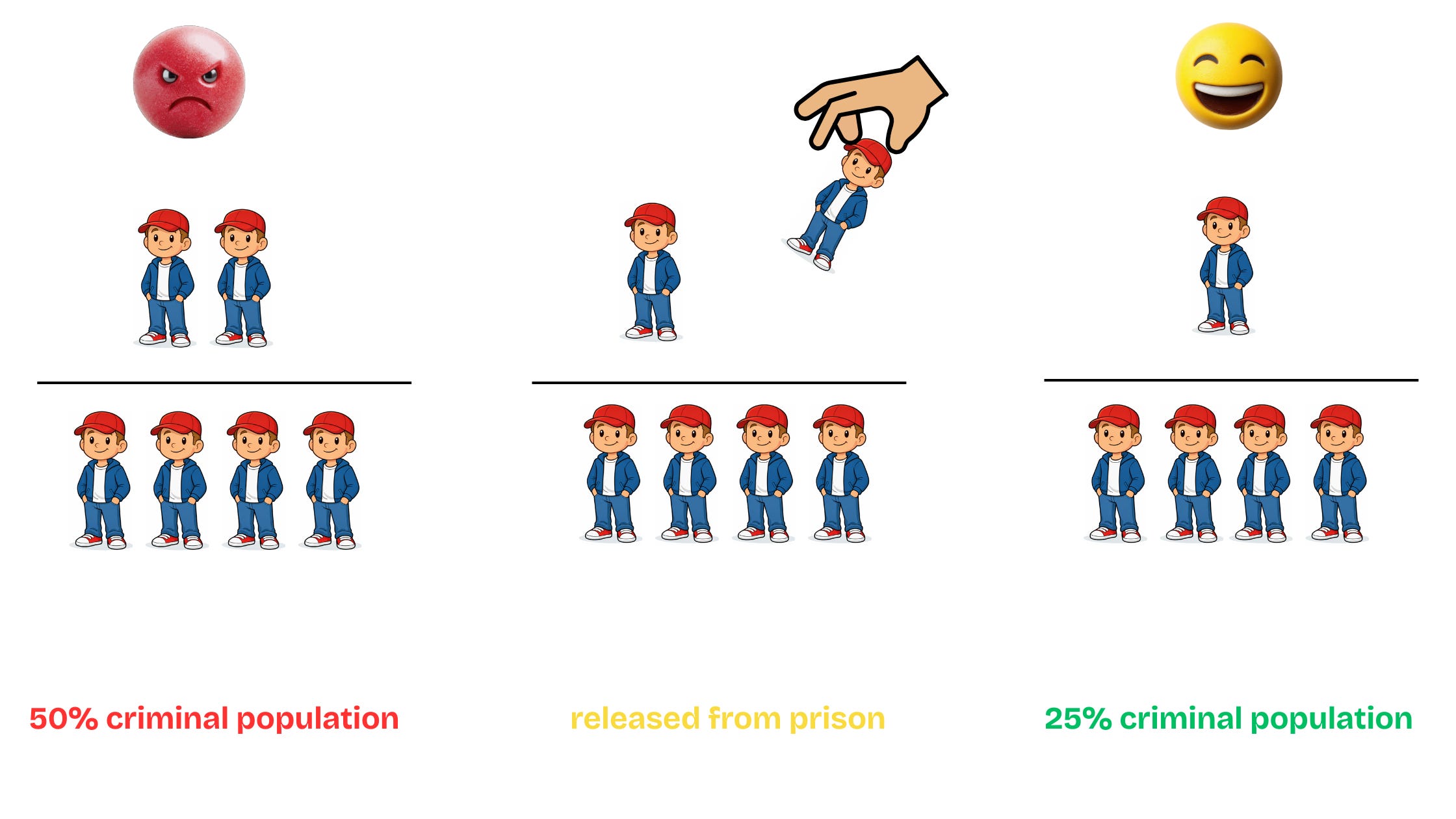
But when a criminal is released from prison then deported, they come off both the numerator and the denominator. They’re not released into society, and aren’t counted in it. The share of the measured population that is criminally inclined still goes down, but not by as much.
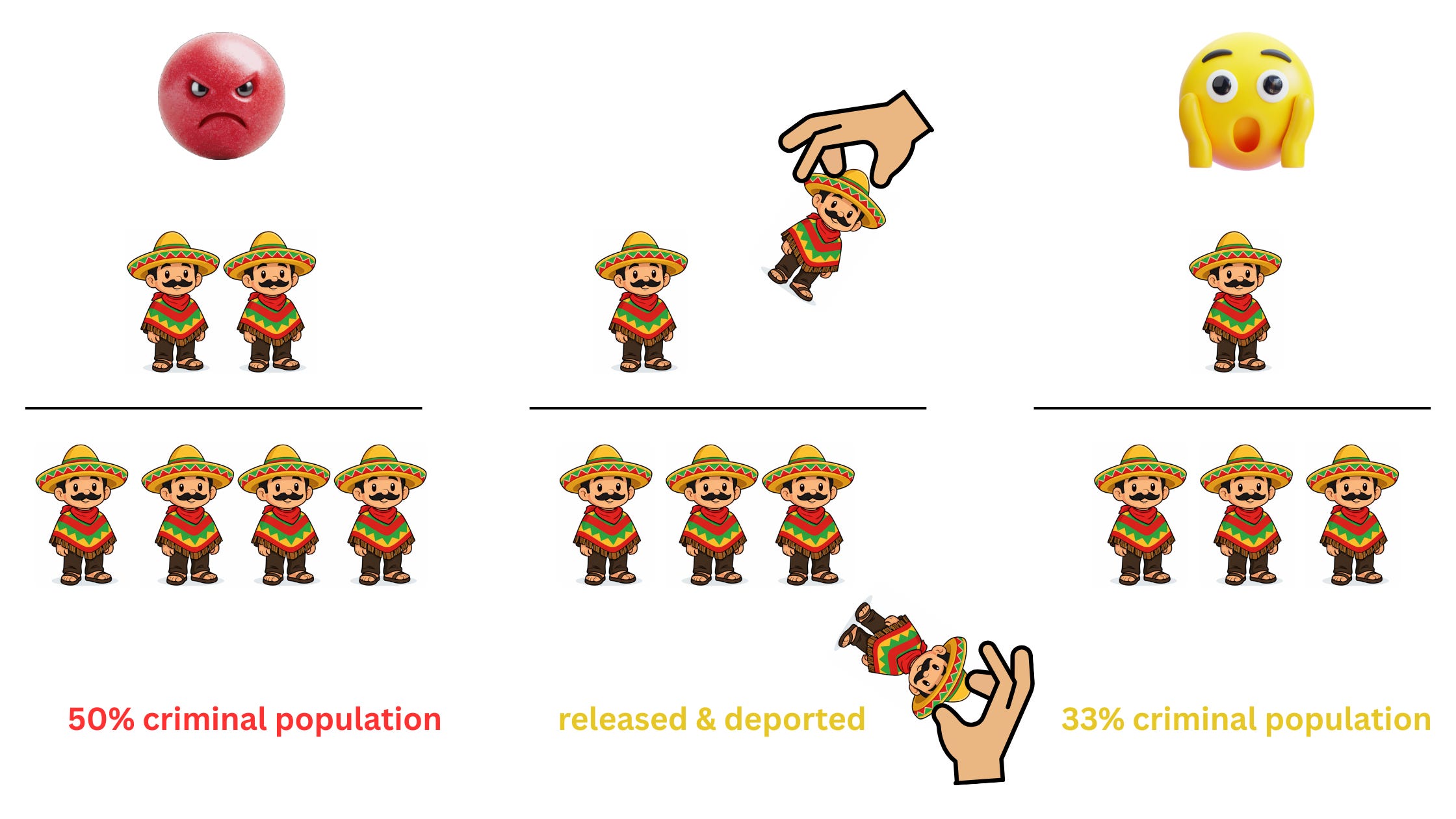
So the effect deportation has on crime statistics pertaining to immigrant communities is not that it incorrectly lowers them, it’s that it keeps the numbers buoyed.
Texas Homicides
I also have a quibble with this section:
The Texas data, often cited as the gold standard, warrant scrutiny. Texas is one of only two states that collects immigration status at arrest. Yet status is initially based on self reporting. Few illegal immigrants arrested for crimes have an incentive to admit unlawful presence. When fingerprints are sent to DHS, identification is delayed and not included in the datasets that researchers are relying on to make their claims that illegal aliens commit fewer crimes than citizens. Texas DPS acknowledges that foreign nationals who entered illegally and avoided detection by DHS but are later arrested will not have a DHS response regarding lawful status and thus do not appear in their counts.
From 2011 through January 2026, TDCJ provided DPS information on more than 34,000 individuals identified as illegal while incarcerated, of whom 11,000 were not identified through Secure Communities at arrest. Researchers knowingly rely only on this intake identification undercount to make their false claims. When prison identified undocumented immigrants are added to arrest data, the 2015 homicide conviction rate for undocumented immigrants in Texas was calculated at 20% higher than the state average, compared to 8% lower using intake only data. Methodological choices alter conclusions. [emphasis mine]
Muse offers no evidence for the bolded claim, and without it, none of the rest of the section really matters.
