

Suicide By Fad
A lesson for institutions - news, entertainment, health, or otherwise: Don't react to the new thing by destroying the old thing.


What do Star Trek, the Washington Post, and youth gender medicine all have in common?
That’s not a riddle. It’s not a joke either, though I wish it were.
What they have in common is: they all gambled items of incomprehensible value on what turned out to be temporary crazes. On passing fancies. Fads.
To Boldly Go Downhill
Star Trek isn’t just a television program, it’s an institution. A canon. For 60 years, visionary sci-fi writers have contributed to building a universe that has captivated average-joe couch potatoes and high-flying change makers alike.
Frank Sinatra was a fan, so was Robin Williams. Barack Obama and Elon Musk are admirers. Family Guy creator Seth MacFarlane was so enamored, he made what was effectively his own version of it with The Orville.
It inspired Sally Ride and Mae Jemison, the first black woman in space. Its cultural value was recognized and praised by public intellectuals such as Umberto Eco and (sort of) Martin Luther King, Jr. Its positive vision of the future was touted by science writers like Isaac Asimov and Arthur C. Clarke, as well as actual scientists like Carl Sagan, Neil deGrasse Tyson, and Stephen Hawking, who was once in it.

Such is the nature of franchises that new installments reflect on past ones. An episode of Star Trek written today doesn’t simply exist in its own vacuum, it’s expected to be canonically consistent with the first episode, which aired in 1966. This holds true for every branch of the intellectual property, including three generations of movies, and three animated series.
All this - all this work, this sweat, this rigor - built Star Trek into one of the most beloved and lucrative pieces of shared property the western world can boast. And then all of it was handed to people who mistook it for their private vehicle to advance whatever causes, grievances, and bugaboos their 2020 Twitter algorithms were feeding them.
After a strong start, Star Trek: Discovery - the franchise’s first small screen venture since 2005 - began to disappoint fans. It felt off.
Story lines came across as preachy and hackneyed, the diversity felt paint-by-numbers instead of authentic, and the military stoicism - a fixture of Trek since day one - was yanked in favor of blubbering, soap opera psychodrama. Of the ten episodes comprising its fifth and final season, not a single one cleared 7.0 on the Internet Movie Database (iMDB); dismal for a high-budget TV show.
Not only did producers fail to reverse course thereafter, they doubled down. Starfleet Academy, only six episodes into its inaugural season, is already the subject of withering reviews, cancellation rumors, and sports a shocking 4.3 out of 10 on iMDB. For reference, Tommy Wiseau’s enigmatic The Room, widely regarded as the worst movie ever made, managed a 3.6.
How did this happen? And why?
The short version is that in the mid 2010s, just as development on what is now disparagingly referred to as “NuTrek” was beginning to ramp up, a new set of norms and behaviors came roaring out of left field to take the world by storm. Call it woke, call it PC, call it cultural Marxism, this new regime and its attendant peccadillos - emotional safetyism, body positivity, gender theory, therapism - were warped deep into the subspace of the Trek universe.

What was once a promotional flag for exploration, abundance, and rectitude became a weepy slop carnival, in which nothing was more important than navel gazing. In which interest in things took a backseat to how those things made people feel. Characters were no longer written to be admirable, they were written to be relatable. Dialogue felt mined from social media, and fans were increasingly left with the impression that they weren’t watching a bright vision of a future in space so much as a teen drama just set there.
This wasn’t only bad television, it was a betrayal. Trek producers had inherited a gold mine, only to dynamite shut the entrance. They came to see longtime advocates less as patrons deserving of entertainment and more as naughty children deserving of correction.
And it was all the result of people mistaking a flash from the pan as the glow of an eternal flame. Many such cases, unfortunately.
All The President’s Meh
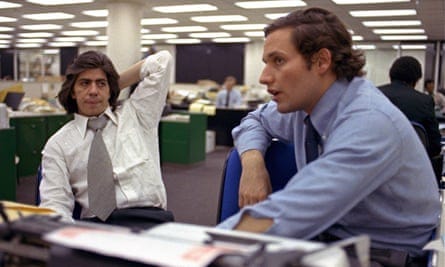
In 1972, a pair of intrepid reporters working for the Washington Post followed a trail of breadcrumbs from a bizarre burglary at the Democratic National Committee headquarters all the way to the Oval Office. What became known as the Watergate Scandal revealed the Richard Milhaus Nixon administration as a cadre of paranoid crooks, led to the only presidential resignation in US history, and forever disabused Americans of the notion that their political ruling class was any morally better than they were.
Bob Woodward and Carl Bernstein became journalistic legends, and the paper that employed them dined out on their reporting for decades. Pre-Watergate, the Washington Post had been little more than a provincial, red-headed step cousin to the larger and more nationally focused New York Times. Now, they were a serious competitor. It takes hard work and dedication to build a brand like that.
Sadly, it takes neither to destroy it.
The Post announced a series of layoffs last week affecting roughly ⅓ of its staff; a devastating blow. They’re all but shuttering their international coverage, ditching sports, and massively down-scaling their arts and culture beats. One might think news like this would hit the country roughly and evenly, but one would be wrong. Outside of expressly left-leaning media spaces, WaPo’s faceplant has been met mostly by cheerful grave dancing.



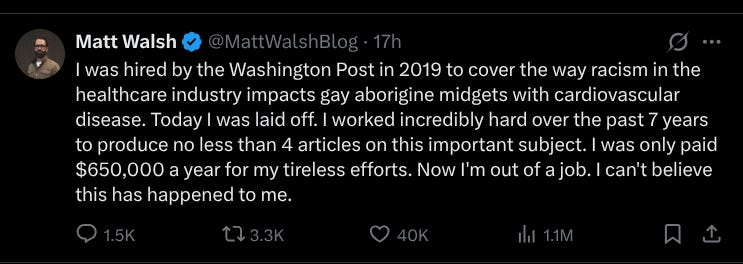
The genesis of this amputation was more complicated than just “The Post went woke,” but that certainly didn’t help, and was a big part of it. The paper lost about a quarter of a million subscribers after they failed to endorse Kamala Harris for president. That isn’t something that happens to outlets whose readerships are there for actual reporting. If people are tuning in to just find out what’s going on, why on earth would they care who the editorial board thinks they should vote for?
There’s nothing new, of course, about journalists leaning left, but the Post went especially hard in that direction. Over the last 10 years, their political and cultural correspondents have virtually all been regime songbirds. In a time of declining subscriber bases industry-wide, WaPo went out and hired a bunch of artless scribes to do nothing but woke stenography and brow-beating. What few conservative readers were still hanging on got dumped into the drink as the ship capsized to port and got trapped in a spiraling maelstrom of its own making.
Here again, it happened because the identity comet was wrongly taken for a new star in the sky. Why not hire a bunch of Grievance Studies grads to write trash takes? Why not addict the readership to fawning flattery, such that a single deviation leads to mass rage-quitting?
Leftist identitarianism was here to stay, wasn’t it? Who needed conservatives? Keeping them around was like keeping fresh batteries in a pager, just in case.
Do No Harm & See No Evil
So again, what do Star Trek, the Washington Post, and youth gender medicine have in common?
They all gambled items of incomprehensible value on what turned out to be temporary crazes.
If good reporting helps us understand the world enough to forge a brighter future, and if Star Trek presented us with a vision of that future, children are that future. You can’t reasonably assign value to a respected franchise or a well-earned reputation, and you definitely can’t assign value to kids.
My fellow parents won’t need to hear this, but they are actually everything.
The topic of youth gender medicine was one I always struggled with, because it set two of my most firmly held beliefs on a collision course with each other. On the one hand, I believe it is the duty of adults - and by extension, the state - to safeguard the young. And I believe that private medical decisions should not be interfered with by people who are not medical professionals - or, by extension, the state.
I am about as qualified to determine how to treat gender dysphoria as I am to edit a national newspaper or pilot a starship. I want the people whose job it actually is to do these things to be qualified, precisely because I am so very not. I am every last bit in favor of space exploration, journalism, and treating unwell children, but the only reasonable role I have to play in those enterprises is just trying to support a system that puts the best people in the best position to oversee them.
It was just reported (though not, at the time of this writing, by the Washington Post…) that that may really not have been happening. That the first detransitioner lawsuit for medical malpractice was decided in favor of the plaintiff. Fox Varian was awarded $2 million in damages for a later-regretted elective mastectomy performed on her when she was just 16.
The story has been taken as confirmation of a fear long expressed by skeptics of gender medicine: that ideologically compromised adults were shunting young people down a path of permanent medicalization for a sometimes fleeting, or even suggested condition.
Fen-Phen, Vioxx, OxyContin, Thalidomide, lobotomies; a misfire on treatment for gender-confused youth would not have been the first time health care professionals lined up behind a care protocol that was later shown to be dangerous. What made this instance so significant was three factors.
First, the scale; in England and Wales alone, and in just 10 years, requests for consultation at the Gender Identity Development Service (GIDS) went up an astonishing 5,400%. Also, the severity of the treatments being administered appropriately turned heads; the prescription of powerful, potentially sterilizing hormones, the removal of healthy breast tissue, in rare cases the removal of genitals.

But overshadowing all this was the absolute insistence that this eruption in self-reported symptoms - mostly in groups not formerly known to be at risk - should be regarded as perfectly, unquestionably valid. Wasn’t this demographic - unstable, adolescent girls - also known to be uniquely susceptible to social contagion; self harm, eating disorders, psychogenic tics, suicide clusters, etc? Wasn’t it reasonable to at least explore other possibilities before signing kids onto permanent, drastic treatment regimens?
Brown University physician and public health researcher Lisa Littman even coined a term to describe the phenomenon: Rapid Onset Gender Dysphoria (ROGD). Her reward? Brown effectively disowned her. They publicly distanced themselves from her work, subjected it to humiliating post-publication review, and allowed her name to be dragged through the mud. She had said that which cannot be said, and was therefore a transphobic monster.
Psychologist Kenneth Zucker’s Toronto clinic, the Centre for Addiction and Mental Health (CAMH) was closed down after Zucker recommended a more cautious approach to treating these youth. Dr. Hillary Cass - British pediatrician and author of the famous (infamous?) Cass Review - was subjected to a crushing internet dogpile for pointing out that the evidence for so-called “affirming care” was worryingly weak. Substack’s own Abigail Shrier and Jesse Singal have been endlessly harassed and slandered as bigots for carefully reporting on the topic.
Not only was this not - repeat, NOT - a fad. To even suggest that it could have been was to risk ensure reputational annihilation. There was one acceptable path: affirmation. To deviate was to invite vicarious suicide threats issued by professionals who should have known that there was never any demonstrated basis for them.
“Kids know themselves,” was the line. And of all the wrong things to ever be wrongly said, this one might be the wrongest. “Kids know themselves” isn’t just wrong, it’s a direct abuse of the truth. The opposite of that statement is close to a functional definition of childhood: the messy process of not knowing oneself and gradually, bumpily figuring it out.
Medicalizing this condition at all, let alone surgically - a condition that bore no objective physical pathology - depended on a series of assumptions that were as unproven as they were fervently held. Youth gender dysphoria was not socially transmitted, it was not temporary, and it could not be managed therapeutically. To even hedge that, perhaps some of these self-reports did not represent true presentations was considered an admission of bigotry.
At least two practitioners (and their unfortunate patient) have now paid the price for that false certainty. Whether, as critics predict, this will be the beginning of a great wave of malpractice suits, or whether these incidents will remain isolated, the first and most central pillar of medicine has plainly been violated: harm has been done.
Futures have been destroyed, health has been ruined, trust has been violated. And by choice. I don’t mean the patient’s choice, of course. We don’t even let kids pick their own haircuts, for fuck’s sake. The impulse to self-destruct in this case was not children’s, it was the people whose sworn duty it was to look out for them.
And while admittedly unseemly to relate children’s welfare to the reputations of news outlets and sci-fi television shows, the same through-line ties all these stories together. The same blunder was made: transience was mistaken for permanence. The ephemeral was thought to be here to stay. And the damage is as impossible to price-tag as the thing damaged.
"I am about as qualified to determine how to treat gender dysphoria as I am to edit a national newspaper or pilot a starship."
One doesn't have to be qualified to treat a disorder in order to recognize it as one.
Do you acknowledge that anorexia exists and that it is a disorder? A disorder with an enormous psychological component? And that no matter how the anorexic feels, no matter that she "feels fat," she in reality is NOT fat and she requires help for her obviously distorted sense of self? And that you by "affirming" her, by going along with her delusion that she's fat, you would be harming, not hurting her?
You don't have to be a physician in order to recognize these things.
Same with the delusion of "transgender." It is a delusion, a fantasy -- at best a belief akin to religious belief, at worst a dangerous delusion causing harm to its adherents and to society at large. Men can't become women. Women can't become men. Nobody can morph into the opposite sex. Liberty allows you to pretend whatever you like about yourself, but not to compel others to do so as well.
https://diagdemocrats.substack.com
We talk about the few brave people who stood up and incurred serious professional damage. But not only will there be no punishment for the villains who visited this on them we need to recognize that these professions are dominated by shriveling cowards who let these kids be abused and the truth tellers destroyed because they feared retribution.
This continues to this day.