

The Guardian’s Immigration Problem
A closer look at seven - now eight - immigration horror stories reveals how narrative framing can distort facts.


A viral story about a British grandmother held for six weeks in ICE detention is currently the talk of social media. The woman’s case is is a strange one.
Karen Newton was on holiday in the US with her husband, who had been living and working there, when they attempted to cross into Canada. They lacked the correct paperwork for their car, so were turned back. On reentry to the United States, border agents noticed that Newton’s husband’s visa had expired, and detained the couple. What followed was an opaque and lengthy detainment, suffered by a woman with no criminal record, and no apparent will to do harm.
The story, reported in The Guardian, is part of what could almost be considered a series by that paper. Since Donald Trump reclaimed the office of president, his immigration enforcement practices have come under serious scrutiny for their pitiless heavy-handedness, and The Guardian has been all over the beat.
Scrutiny is good. Americans and foreign visitors alike deserve answers to important questions, and The Guardian is ideally positioned to spotlight a system that can be as complicated as it can be unforgiving.
It’s a shame then, that The Guardian is so unutterably bad at it.
Almost immediately after Newton’s story hit the wire, social media users had…questions. This author has a few of his own, but we’ll get to them later. It seemed unbelievable that ICE would really detain this woman for so long, for only the reasons stated in The Guardian’s reporting.
That word - “unbelievable” - isn’t necessarily one you want associated careful reporting. Though, as we will unfortunately see, *careful reporting* isn’t quite The Guardian’s business these days. And “that’s unbelievable” (not meant in a good way) is a rebuttal they have duly earned.
A little about me:
I have an admittedly low susceptibility to immigration sob porn.
It’s not that I don’t empathize, it’s that I’ve lived a lot of it. I know what the headaches feel like. I know how stressful it is to deal with immigration authorities in a country where much of your life is invested, and I know how positively byzantine some of the rules and procedures can feel.
By my count, I have lived in four foreign countries long enough that I had to extend my stay there. I got to know the immigration systems of those countries quite intimately, through hours-long study sessions, lawyer consultations, and lots and lots of institutional support from employers or educators. At no time was this a fun or enjoyable process, and in one case, I screwed up badly enough to get myself kicked out of a place I’d been living for six years.
But my experience has also given me a pretty keen nose for bullshit. I can generally smell it when the heart of an immigrant strife-saga lies in the fact that the subject was either:
a) playing fast and loose with the rules (or violating them outright)
b) failing or forgetting to comply with them fully
c) assuming or hoping the rules wouldn’t apply in their case
We are being massively failed by legacy media’s coverage of US immigration policy. This is a subject of intense national interest, and there has arguably never been a more important time for people to understand the full contours of the debate. It’s a problem then, that the journalists whose duty it is to keep us abreast of what’s happening are falling down so hard on the job. It’s a travesty, and nobody is made more vulnerable by it than folks who might actually like to avoid winding up in ICE detention.
We’re going to look at seven, separate stories now. For most of them, my vote, if I had one, would be that the main character be allowed to stay in the United States. But that really doesn’t matter except to my individual, emotional satisfaction.
Framing these stories (as legacy media loves to) as being about cruelty and immorality doesn’t add anything meaningful to immigration discourse, and it doesn’t help people understand it. The United States is the most immigrated-to country on the planet. We need laws to manage that, and they need to be dispassionate laws. When people break them, the consequences need to be clear, expected, and reasonable.
In all of the following (genuinely tough) situations, the law, however strange-seeming, was followed. You wouldn’t know it from the reporting - all courtesy of The [inestimable] Guardian - but the unfortunate victims of ICE detention we’re about to meet all landed themselves in it.
No, they didn’t mean to. Yes, ICE detention is terrible and Kafkaesque. No, our system shouldn’t work like this. Yes, there should be more humane ways to treat people who obviously pose no danger to Americans.
So what suggestions does The Guardian have for tweaking our system? None.
What advice does it offer to future travelers hoping to avoid these missteps? None. Or, none beyond: “Don’t come,” an admonishment that even appears in their headlines.
This paper prefers writing tales of woe, featuring ultra-sympathetic travelers (prepare to hear a lot about their sick, dead, or in-love-with-them relatives) getting caught in an unfeeling and incomprehensible system, then being subjected to unfeeling and incomprehensible detention, usually in miserable conditions. That’s where the clicks are.
Oh, there’s another common denominator too. Something that all the protagonists have in common - besides sick, dead, or in-love-with-them relatives. I wonder if you’ll spot it. We’ll check back at the end to see if you did.
But I’ve been telling. This will be more interesting if I show.
For each yarn, I’ll present the Guardian’s framing, then what actually happened. Then I’ll explain what would happen if we simply removed the offending immigration law that triggered the problem, and finally, I’ll suggest a more realistic fix that would prevent future instances of trouble.
Case #1: Cliona Ward
What The Guardian reported:
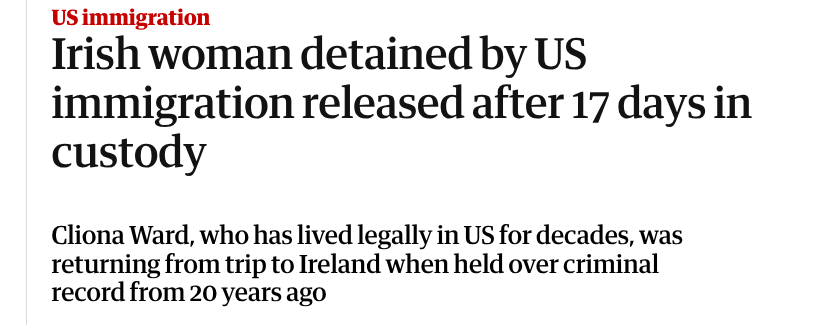
Cliona Ward, an Irish woman who immigrated to the US as a child, was returning from a visit to her sick father when border agents detained her, dredging up a decades-old, already-expunged criminal history as pretext. She was initially released to obtain documentation proving her criminal record’s expungement, but was detained again when she returned to present it.
Ward is the sole carer for her special needs son and has been in the United States on a green card since the age of 12. She has taken many trips to Ireland in that time to visit family and never had a problem before.
What The Guardian obscured or left out:
Green cards are not unconditional. Any of Ward’s previous trips to Ireland could conceivably have landed her in trouble, and she could have been deportable even without the travel. Her criminal history was tied to drug addiction, and her multiple convictions were for drug possession and (apparently, reporting is shaky due to the state expungement) minor theft.
That makes Ward quite sympathetic to the public, particularly as she has reportedly been in recovery for years. But drug convictions are taken seriously by ICE (Immigration and Customs Enforcement) and CBP (Customs and Border Protection). That’s not a Trump thing, that’s always been the case. A record like Ward’s can be grounds for immediate deportation or - as in this case, inadmissibility - even with a valid green card.
When Ward returned to present proof of her record’s expungement, she was seemingly unaware that expungement at the state level doesn’t transfer up to the federal level. But it doesn’t. As far as CBP/ICE was concerned, her convictions stood. While I doubt it feels like it to her, she’s actually quite lucky she was allowed to stay at all. Without involvement from the Irish government, she almost certainly would have been removed from the United States.
What would happen if we scrapped this law:
ICE and CBP use prior convictions - especially for drug offenses - as regular grounds to regard green card holders as deportable or inadmissible. In Ward’s case, this was sad, because Ward appears to have been more in the category of *criminally addicted* rather than *addicted criminal* - but border officials aren’t obligated to respect that distinction. For all they knew offhand, Ward was a trafficker, and even if they’d found out that her convictions bore a different context, that’s not a guarantee she didn’t just plead down to lesser offenses.
She may even have done that - California regularly expunges drug records in the event probation conditions or recovery benchmarks have been met.
Bottom line, it’s not unreasonable to assume that past convictions are more often used to boot out genuine criminals rather than formerly down-on-their-luck addicts. And it’s probably not a great idea to remove the ability of border officials to act against folks in this category just because some of them have friendly faces and sad stories to tell.
Bottom, bottom line, Ward repeatedly violated the laws of a country in which she was a guest. She wasn’t allowed to do that, and per that country’s laws, it made her eligible for removal.
How this could be avoided in the future:
I don’t see why the state’s expungement - of which Ward had proof - wasn’t enough to at least keep her out of detention. It’s hard to understand the timeline here, and The Guardian has unfortunately not much clarified it, but it looks like there was a sizable gap between border agents telling her she needed to report back and her actually reporting back. Maybe there was an explanation for that, or maybe she took so long that they considered her a flight risk, but coming back at all should have allayed that fear.
Stable, consistent enforcement of immigration law could also have prevented this, even if it means more rigid treatment of more people. Ward was lulled into a false sense of security by her multiple, trouble-free trips to Ireland prior to her detention, even though any one of those could have seen her removed. The law in this case gives border officers a lot of leeway though, which maybe isn’t a great system. You don’t want your entire life to be in the hands of a single agent who may or may not just be having a bad day.
Case #2: Jasmine Mooney
What The Guardian reported:
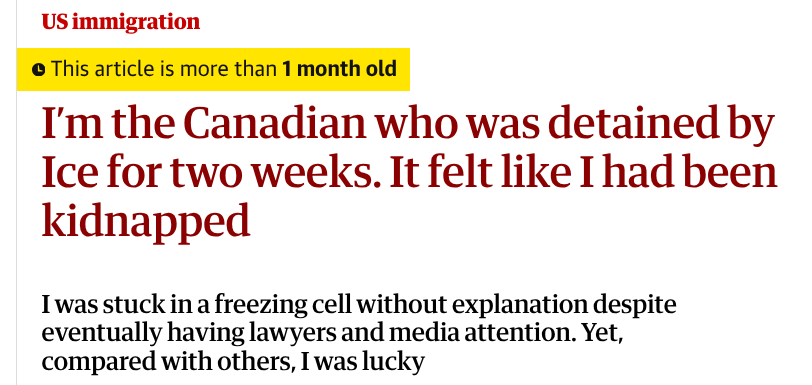
This one was well covered due to Mooney’s having formerly been an actor of some repute. She was trying to relocate to the US to work for a wellness startup that dealt with hemp products. She tried entering the country through the TN (NAFTA/USMCA) program that’s: Trade - NAFTA (North American Free Trade Agreement) - United States-Mexico-Canada Agreement, but she was told that was the wrong category and that she needed to return to Canada to reapply.
She did, but wasn’t aware that she needed to do this at a consulate and not simply reenter the United States with new paperwork. Instead, she went back to San Diego - where her lawyers worked - and tried again. This landed her in pretty frightening detention for two weeks before she was allowed to go back home.
What The Guardian obscured or left out:
The Guardian printed Mooney’s firsthand account of her ordeal, which obviously focused more on the horrors of her detention than on what she did to trigger it. But she did really screw up, and in a very risky way; one she, and The Guardian, might have bothered to warn others about.
By going back to San Diego instead of the consulate, Mooney placed herself in a category akin to “repeat offender” (those aren’t the precise words, but that’s the gist). She’d been refused entry once already. Now, she was back to try again, having failed again to comply with the rules. That meant administrative detention, and it didn’t matter that she was a pretty Canadian lady.
If anything, her identity made things worse for her, because her situation was so unfamiliar to ICE officials - some of whom come across as kind and concerned in her narrative. They couldn’t answer her questions about how long her case would take to resolve because they didn’t know. It wasn’t the kind of case they were used to seeing. That must have been legitimately horrifying for her.
What would happen if we scrapped this law:
All the laws that were followed here are sensible ones under regular circumstances. We want NAFTA entries to be restrictive so they aren’t abused, and we want border agents to take repeat offenders more seriously. Really, the only reason this case triggered outrage is because Jasmine Mooney is a hot Canadian lady who made a mistake, rather than a Guatemalan lettuce picker on his eighth attempt, or a cartel mule with a butthole full of smack balloons.
How this could be avoided in the future:
There should never have been any question of Mooney’s eligibility for TN (NAFTA/USMCA) - she wasn’t eligible. That’s a narrow, employer-specific program, and it’s not intended for entrepreneurs. Use of hemp is also a gray area and one that probably should have halted the process before it resulted in her thinking she had permission to enter the US (the first time).
Past that, it’s unfortunate that Mooney didn’t know that she could not simply come back to the US, and that she had to visit a consulate first. Maybe the border agents’ didn’t make that clear to her, but it’s not their job to explain the ins and outs of the law to people they’re removing. Still, better clarity and communication are always good things.
Also - and a consistent theme - faster and better processing times would help. It should not have taken two weeks to notice that they were holding a hot Canadian woman who had the means and the will to return home at any time. No sane person thinks that’s who our system should be designed to detain.
Case #3: Jessica Brösche
What The Guardian reported:
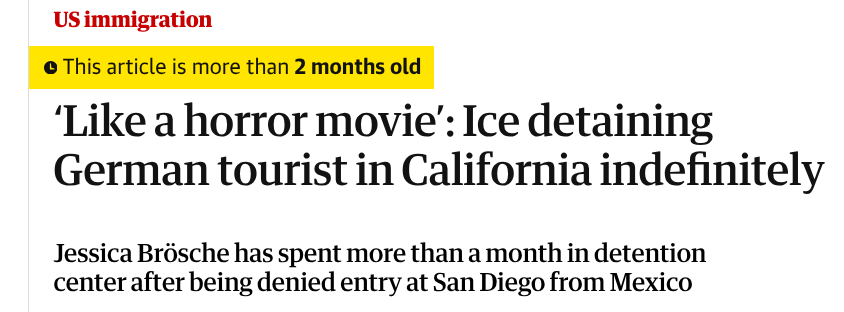
Brösche was a German “tourist” who was detained trying to cross the border from Tijuana into San Diego using the Visa Waiver Program (VWP). She is a tattoo artist and was carrying her tattooing equipment.
What The Guardian obscured or left out:
This paragraph is buried in the middle of The Guardian’s account of Brösche’s harrowing experience. Let’s see if we can’t spot any clues as to how this could have happened:
“According to KPBS, US Customs and Border Protection accused Brösche of planning to violate the terms of the visa waiver program by intending to work as a tattoo artist during her time in Los Angeles.”
Maybe, as I am, you need to be covered in tattoos and friends with several tattoo artists to understand the red flags that CBP and ICE were spotting here. Tattoo equipment is heavy, clunky, and extensive. There is exactly one credible reason for carrying it with you on an international trip and that is that you intend to use it.
Since tattoo artists don’t work for free, border agents had every reason to suspect that Brösche was intending to work illegally in the United States. That moved her case from the whoopsie category into the fraudulent application category, and the Visa Waiver Program is clear and unsparing about what that means. She was not entitled to a judge, a bond hearing, or a statutory deadline for removal, and since it was Germany they were sending her back to, it wasn’t just a matter of popping her on a bus back to the border.
What would happen if we scrapped this law:
The whole point of the Visa Waiver Program is that you’re agreeing to certain conditions in advance, in lieu of obtaining a visa. One of those conditions is that you aren’t going to work. I feel bad for Brösche because ICE detention is rough. And an artist getting thrown a few bucks to tattoo a rose on some guy’s chest in some other guy’s garage (you might be sensing that I have some experience here…) isn’t going to destabilize the US economy. But the violation was clear in this case, and the rule being violated is a fair one.
Brösche might as well have been lugging a massage chair while insisting, “No, sir, what gave you the idea that I was planning to massage clients?”
How this could be avoided in the future:
Pretty simple: don’t break clear and obvious laws. If you’re going to, lie more convincingly about it.
Case #4: Seamus Culleton
What The Guardian reported:
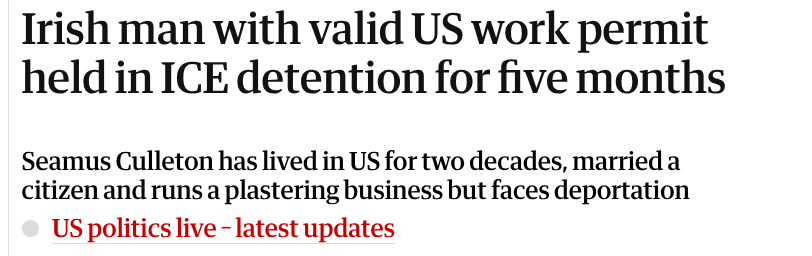
In this case, Seamus Culleton had been in the US for almost 20 years before ICE picked him up. He’d overstayed a visa in 2009, but had since married a US citizen, was working legally, and was held in prolonged detention under pretty grim conditions. All of this is true.
What The Guardian obscured or left out:
Buried in The Guardian’s reporting, or missing altogether, are the details of how this was allowed to happen in the first place, and why Culleton was subjected to such harsh detention conditions. Working backward, and as the piece admits, Culleton opted for detention over deportation. Of course he did. He has a wife and a business in the United States.
But ICE detention isn’t structured for expedience, and at the time ICE got to him, he had only those two options; voluntary removal or detainment.
Why could he work? Because authorization to work while applying for a green card is a different statutory process from remediating the overstayed visa. It’s a case of the right hand not always knowing what the left hand is doing. These issues can take years to resolve, and it’s obviously not reasonable for people to remain unemployed for such a long period of time. So often, they’re allowed to work.
But neither that authorization nor his marriage to an American granted him legal residence. What he had instead was what’s called “authorized stay without lawful status,” and that left him vulnerable to bad luck. A good way of thinking about this case is that Culleton fell through a bizarre crack in the system and then was bizarrely discovered living in it many years later.
What would happen if we scrapped this law:
Here again, none of these laws are bad per se, or even really that harsh. Green cards take way too long to issue, but we probably want to keep issuing them. And we want people to be able to work while their cases are decided. We also want visa overstays to be discouraged but not necessarily dealbreakers, especially in the event you later marry a citizen.
Culleton just hit a quagmire of bad fortune. He was picked up in a raid of which he was not the target, with a legal driver’s license and work permit, but no legal status. He was married, but hadn’t gotten citizenship or a green card. He owned his business legally, but wasn’t in the country legally. He was participating faithfully in the process, but the process wasn’t concluded.
Which of these laws would we drop or reform just to avoid this unique set of circumstances?
How this could be avoided in the future:
This guy was not a flight risk. He had technically waived his right to a judicial hearing that could have granted him release on bond - that would have been a term of his entry under VWP in 2009. And that program is intended to be unforgiving - you “waive” your right to a number of protections in exchange for streamlined simplicity.
That said, there should have been a more reasonable pathway to his petitioning for a hearing anyway. Keeping people like him in detention is expensive and makes no sense. There should have been a much speedier pathway to releasing him to conclude his green card application process from home. He wasn’t a criminal, ICE wasn’t specifically looking for him, nor was he specifically dodging them.
Case #5: Rebecca Burke
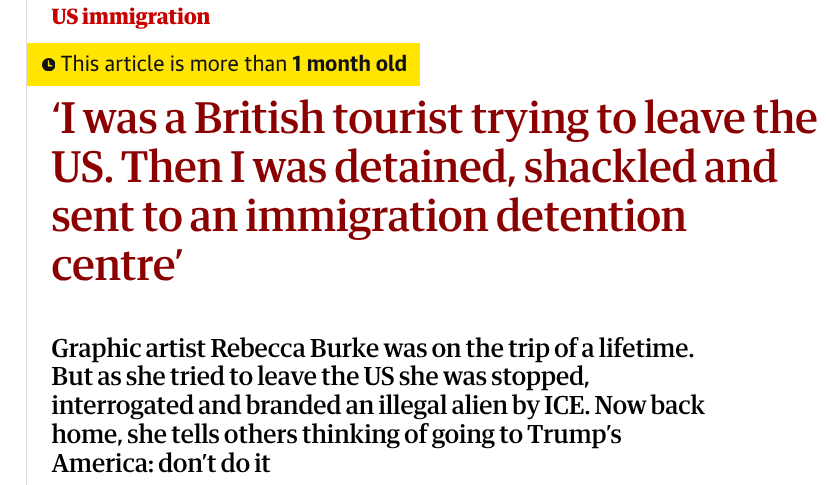
What The Guardian reported:
This article tries very hard to avoid informing us of the blunt, simple reason why this young woman was detained. When finally, 17 paragraphs in, the journalist gets around to it, here’s what we get:
“Then she was told she had violated her tourist visa by working in the US.”
On the way to this revelation, we hear about Burke’s free spirit, the sweet comics she draws, her friends back home, her love of travel, her dog, a horror story involving a transgender friend of a friend, and we hear about the Biden to Trump transition.
What does all that buildup get us? Not really anything, it turns out. The whole 39 paragraph ordeal that is this article boils down to: she admitted to working on a tourist visa after first lying about it.
What The Guardian obscured or left out:
It’s all here, but boy do you have to dig.
A few things are meant to make Burke’s story especially sympathetic. I’ll leave it to your judgement whether or not they do.
Burke appears not to have known that work in exchange for accommodation counted as “work.” Okay. Maybe. But is that reasonable? It clearly is a violation - a serious one - but hey, maybe she didn’t know it was? She’s young, after all.
We’re also supposed to balk at the length of her detainment - and this is fair. She was held in ugly conditions for a pretty long time. But as we’ve seen, removals to Europe can take awhile. It’s not as common a destination as South or Central America, and ICE doesn’t especially care about traveler inconvenience once they’ve caught one lying to them and breaking the law - which is technically what Burke did.
What would happen if we scrapped this law:
We shouldn’t. Burke was on a tourist visa, and had really no excuse to think she was permitted to work. We don’t want tourists abusing their visas to work, and we don’t want to have to subject them to the higher level of scrutiny we apply to prospective workers. Unless we want it to take weeks or months to get a tourist visa.
The site Burke used to book her employment made clear that it was her responsibility to ensure she was applying for the correct program, and she did not do that.
How this could be avoided in the future:
I don’t know. Is there really a policy fix for this? Do people really think they can work on tourist visas? Do they think payment in kind makes work not work?
Case #6: “Jonathan”
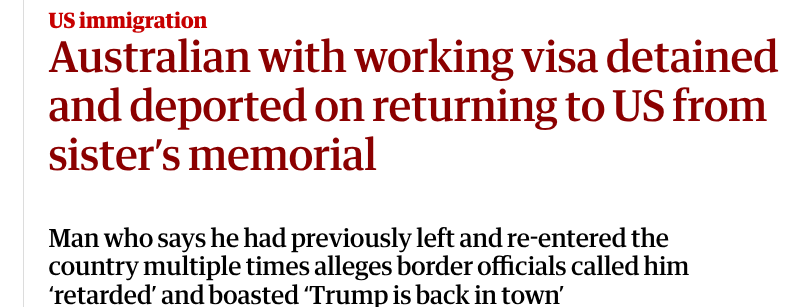
What The Guardian reported:
After a visit back to Australia to grieve his sister, “Jonathan” returned to the United States and ran into trouble at the airport. The Guardian focuses mainly on his rough, supposedly abusive treatment at the hands of CBP and ICE, and mostly doesn’t dive into why Jonathan’s visa was actually canceled.
The article relies overwhelmingly on Jonathan as the primary source, and for a few reasons, I’m not sure how much we should trust him. His account feels very…on the nose to me - “Trump is back in town?” Really? And the details he highlights feel hand picked to trigger Guardian writers. I’m going to quote my favorite passage of all seven of these:
“The disaster began at border control in transit in Houston, Texas, when he was pulled aside and taken to a “secondary” room, he says. Posters hanging on the walls that had once celebrated diversity, equity and inclusion, had been crudely updated with a black marker pen, with mentions of DEI scribbled out. About 100 people from around the world sat and lay in various states of worry and exhaustion, he says.”
They blotched out the DEI posters? The humanity!
This part also makes me squint:
“They didn’t give me any valid reasons for cancelling my visa. I’ve spoken to a bunch of lawyers and they all say I could fight it but that it would cost thousands and probably take five years anyway.”
As we’ll see, they absolutely had reason to cancel his visa, and any lawyer worth their salt would have told him exactly what it was. Maybe his story played out exactly as told here, but this strikes me as very credulous reporting. And, like the other installments we’ve seen, it mostly leaves out the details that would kick this down a notch from “evil and unfair” to “bad luck but valid.”
What The Guardian obscured or left out:
Customs & Border Protection have very broad powers. They’re not clerks and they’re not the TSA. Even if you have a visa to enter the United States, it is CBP’s prerogative - on every entry - to determine that you no longer meet the criteria.
Jonathan’s visa category expressly prohibited him from “living in” the United States. Maybe pretending he wasn’t was a dumb pretense for him to have to maintain, but the law in this case is very clear, and so was his violation of it. What’s called “immigrant intent” is sufficient reason for CBP to determine that you aren’t in compliance with the terms of a visa, and Jonathan went quite a ways out of his way to make clear that he wasn’t.
He told them “I live here.” (Not supposed to say that.)
He was in Australia for a very brief visit. (Suspicious, for somebody who ostensibly lives there.)
He made clear he had a romantic partner in the States. (Bad move.)
He made clear he had been living in the states for years. (Very bad move.)
It’s harsh but it’s how it works. Jonathan was gaming a visa type that is much easier to obtain than the kind of permanent residency that would have better reflected his living situation. Thousands of people do this every year and get away with it, but it is technically against the law, and he did make it very clear that he wasn’t following the rules.
What would happen if we scrapped this law:
Doing away with these categories would very likely gum up the works and make everything take longer for everybody. The idea of temporary work visas is that they take less time and rigor to issue, because we’re not having to give you a permanent thumbs up or thumbs down. Realistically, closing this loophole would mean bringing the temporary work standard closer to the permanent resident standard, which would make it take longer. The alternative would be a system that was easier to abuse, and a harder time removing abusers.
How this could be avoided in the future:
It should go without saying that I do not approve of ICE agents asking people if they are retards. If we choose to believe Jonathan that this happened (I’m a little skeptical…) we should definitely start by ending the practice.
After that, the “immigrant intent” standard seems unduly loose to me, and the line between “living” and “staying” is blurry. Obviously, people are going to be seeking residence if they’re working in the US long term (they’re allowed to). Obviously, they’re going to refer to that residence the way everyone does: “home.” Simply saying the wrong words should not be grounds for removal.
But…
I’m not sure I buy that that’s really all it took for Jonathan to fall afoul. He states that he was interviewed for 30 minutes. This is called secondary inspection, and it is not just a second round of passport check. If this is happening to you, you are officially under the microscope, and you are not free to leave or decline. He had very little luggage, he had a travel history that looked more like somebody returning to a permanent residence than somebody traveling for work, and if the permanent foreign residence he was required to maintain in Australia looked like a facade, like because his visit there was so short, agents would have had plenty of grounds to yank his visa.
Case #7: “Thomas”
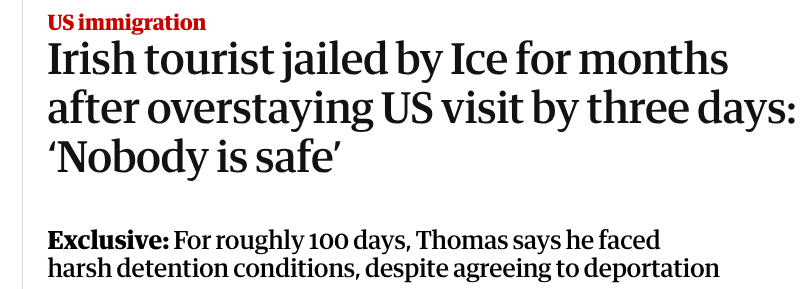
What The Guardian reported:
This one is almost criminal in its credulity. “Thomas” was visiting his girlfriend in West Virginia when he overstayed the Visa Waiver Program due to a health emergency. He tore his calf and says his doctor told him to avoid travel for 12 weeks due to a risk of blood clots. This resulted in his having to overstay his visit under VWP for three days. He attempted to contact the Irish embassy and DHS with his doctor’s note but didn’t hear back. An unfortunate encounter with law enforcement during his overstay period landed him in ICE custody where he remained for nearly 100 days.
What The Guardian obscured or left out:
The bullshit is strong with this one.
First, let’s examine the timeline. The Visa Waiver Program is only good for 90 days. 12 weeks of no travel amounts to 84 days. So per The Guardian’s account, this guy got to West Virginia just in time to tear his calf and be examined by a doctor. He was told to wait 84 days and overstayed by 3, so this would have to have happened on day 9.
Plausible enough, but he didn’t think to ask his doctor if 11 weeks and 4 days would be enough rest time to avoid clots? It had to be a full 12 weeks? He had to have those three extra days or he’d die?
Out of interest, I asked ChaptGPT, Grok, and Google Gemini how long it’s recommended to wait after tearing a calf muscle before traveling on a plane, if one wishes to avoid the risk of clotting. The longest answer I got was 2-4 weeks. There doesn’t seem to be any documented risk of clotting outside that window, and a torn calf only takes about 6-8 weeks to heal total. So who was this cautious, cautious doctor he saw in West Virginia?
And those three extra days just happened to coincide with a trip to Savannah to visit his girlfriend’s family? And he hadn’t actually booked a flight home?
Smell test: failed.
And let’s talk about what happened in Savannah. The Guardian says he “suffered a mental health episode” while staying in a hotel. The police were called and he was arrested - over his girlfriend’s objections - for false imprisonment.
This is a truly incredible framing for an ostensibly liberal newspaper.
Translation: he and his girlfriend had a domestic that got rowdy enough for neighbors to call the cops. He was arrested on the grounds that he was preventing his girlfriend from leaving the room - a classic DV move, and one that cops have seen a million times. Also common to this pattern of abuse: the victim doesn’t want the abuser charged. They cover. They excuse. They ask for “treatment” instead.
The Guardian presents the girlfriend’s wish for him not to be arrested as somehow exculpatory. It fucking isn’t.
Under Georgia law, arrestees who are in the country illegally - which by this point, Thomas was - are automatically referred to ICE. Because he’d been arrested for a violent crime, and because this was right after Trump retook power, his case got lost in the shuffle and his detention was lengthier than is typical for somebody who’s agreed to removal.
But again, as far as ICE was concerned, this man was a violent criminal. Check out this admission, buried in the bottom third of the Guardian piece:
The authorities did not explain what had changed, but two armed federal officers then escorted him on a flight back to Ireland.
Whoa there, Guardian….“on a flight?” Not “onto a flight?” They escorted him on it? Unless this is just unclear wording, armed agents escorted Thomas all the way back to Ireland. That is not done for people whose only mistake is a three day overstay. That’s done for high-risk removals.
What would happen if we scrapped this law:
We should not scrap this law. We do not need lying, domestic abusing pieces of shit visiting the United States. Fuck “Thomas.” His travel ban should be permanent.
How this could be avoided in the future:
Don’t overstay your visa. Don’t abuse your girlfriend. Problem solved.
Bonus: Case #8: Karen Newton
Regarding Karen Newton’s viral case, the one at the top of this piece, I have some questions, some guesses at answers, and can think of several threads on which I might have pulled had the reporting been my assignment.
What was her husband doing in the United States?
This was not a simple case of tourists on vacation. Mr. Newton was already living and working in the US. His wife was visiting him for a lengthy holiday despite his legal time in the country being up. The B2 program, which Mrs. Newton was using, is a non-immigrant visa. If ICE thought her behavior looked more like she was joining her husband to live permanently, that would have led to border agents canceling the visa on her reentry.
B2 also forbids helping another immigrant enter or remain in the country illegally - that’s true of all US visa programs. Is helping your husband pack - what Newton says she was told her offense was - really aiding or abetting?
Well…yes. It literally is. It’s called Alien Smuggling. Here’s the language in the statues: “Persons who at any time knowingly encourage, induce, assist and abet, or aid any other to try to enter U.S. in violation of the law are inadmissible.” That goes for helping minor children, and yes, it goes for helping loving husbands.
Were the Newtons trying to enter the US? Yes.
Was Mr. Newton trying to enter illegally? Yes.
Was Mrs. Newton helping him? Yes.
Did she know he lacked legal status? Not reasonable to think she didn’t - she was married to him, and they’d been traveling extensively together.
They try to drive past it, but The Guardian piece offers a few other clues that suggest agents may have had cause to look twice at the Newtons. Quite a ways into the article, the reporter drops this tidbit:
Bill had been working in the US with a valid work permit, but did not have a green card – fed up with the appeals process, he had decided to leave and retire back in the UK. [emphasis mine]
You “appeal” a denial. So had Bill’s green card application been actually denied? Saying he was “fed up,” and that he “had decided to leave and retire back in the UK” implies that the process was maybe just taking too long and that he was impatient. But “appeals” aren’t something you go through unless there’s been a refusal.
And why wasn’t his wife already with him? How long had be been there?
The Guardian wants this story to start with their charming holiday, but there’s very unusual background here that almost certainly played a role in the pair being flagged by ICE. Particularly if, from ICE’s perspective:
Here’s a guy who’s trying to immigrate, has applied for a green card, and been denied.
He’s been in the country illegally already, now he’s trying to get back in, and his wife has joined him.
His wife completed a lengthy application process promising that her intent was not to immigrate (the B2 application presumes immigrant intent - the burden is on the applicant to prove their travel is for other purposes).
What happened with the husband’s detention?
Why isn’t this part of the story? Bill’s detention is barely referenced. The couple were separated and held for the same amount of time. Why is only Karen’s story being told?
As we’ve seen, lengthy ICE detainment usually only happens when agents suspect some kind of foul play. The omission of a full half of this saga is suspicious in the extreme. If the explanation for Karen’s detention lies on Bill’s half of the story - and even per what little reporting The Guardian bothered to do here, it does - why aren’t they telling us more about that?
Does ICE really pay agents bonuses per detainment?
This is referenced many times in the piece. Karen came to believe that she was being held so that whatever ICE agent detained her could get a cash bonus. But does ICE actually award agents such bonuses? They’re quoted in the piece flatly denying that they do, but the article continues on as though their denial was never issued.
Fact check.org found no evidence for these bonuses, and suggests that belief in their existence might stem from a misunderstanding of a Wall Street Journal article about overall deportation targets.
This is kind of an important detail, right? I mean, I’m just a lowly writer - certainly not a trained journalist reporting for the august Guardian newspaper - but if a whole article supposes a financial incentive for someone’s detention, and the government program that offers those financial incentives doesn’t actually exist…that’s relevant, no?
Why didn’t Newton tell people what was happening?
Here’s another odd detail from the piece:
Karen may have been released sooner had she shared her story earlier. But when she was in the detention centre, she had balked at the idea. “I was mortified at the thought,” she says.
Not to sound like Dr. House here, but people feel mortified when they’ve done something wrong (or a loved one has). There is nothing shameful about being wrongfully detained, and people in that position tend to want to shout their innocence from the prison rooftop. What did Newton feel mortified about?
Put yourself in her shoes. You’re in jail. You’ve done nothing wrong. You had the means to leave the country, and volunteered to do so. You’re still in jail. You have the ability to contact the outside world. You…don’t?

Why was the British diplomatic corps unable to intervene?
Resolving situations like this is the bread and butter of consular staff. Why couldn’t they help? The piece makes it sound like they were just vaguely shit at their jobs, but if true, that’s very unusual, and a very big deal. As we saw in some of the cases above, as soon as foreign pressure is applied, things can speed up. Why didn’t they here?
Maybe this is all exactly what happened. Maybe the consular caseworker just had a hangover that day. Or maybe there was some reason they couldn’t get ICE to expedite.
Why was there such a long delay between agreeing to voluntary removal and actually leaving?
This fact is presented as *sadly par for the course* but it really isn’t. Six weeks for a simple visa cancellation is a very expensive, very aggressive action. It’s possible the shutdown affected the pace of removal, but by Newton’s own reckoning, that wasn’t it - people were being removed, and ICE staff was active during the shutdown.
So what was the deal? She could pay to leave, she was willing to leave, she’d agreed to leave, so why did they spend tens of thousands of dollars to keep her locked up?
It only makes sense to leave a quibble like this unresolved if the system is so incompetent and insane that, “well, of course they did that - it’s just what they do.” Certainly, that’s the meta-narrative The Guardian has been pushing with these stories. But it’s really not what ICE and CBP do. If all The Guardian’s reporting is accurate, and nothing was omitted, Newton’s treatment was a serious outlier, even by ICE’s already uncompromising standards.
If there really isn’t some mitigating factor we aren’t hearing about, then honestly, Congress needs to investigate. Not only shouldn’t we be treating people like this, we shouldn’t be paying for the privilege.
Why was Newton allowed back into the US at all? And why did they offer her Project Homecoming money?
These are perhaps the story’s most confusing details. She wasn’t in the US when this saga started, she was in Canada, crossing back. If CBP canceled her visa at the border, she should have still be okay to enter Canada. Brits don’t need visas for short visits there, and it was reportedly the car paperwork that was the issue on her initial entry. Why didn’t she just go back to Canada? Why did US border officials detain her? Why did they even let her in?
And why, once she was in, and in detention, did they offer her Project Homecoming? That program is designed to expedite removal. It’s chiefly for immigrants who are already living in the US, so that they’ll come forward and agree to leave. When they do, detention is not typical.
Conclusions
Nothing about this case was typical. It should not have happened.
Which I do not mean as some nebulous lamentation, I mean this should not have happened, so why did it? What made adorable British granny, Karen Newton’s case so distinctive?
The Guardian would like us to conclude that it’s simply because…evil. They’d like us to trust them this case wasn’t an outlier, but emblematic, and that any details they may have left out, or questions they may have ignored aren’t relevant. They’ve given us all the facts we need.
My question: have they earned that trust from us?
Oh, and having wrapped up, did you spot the other consistent theme? The similarity in all eight of these cases?
These narratives work so well as sob stories because the victims are all white people. That’s why The Guardian selected them. The brown people these white people are all locked up with are just side characters. Barely even that, they’re set pieces. The Guardian doesn’t bother telling us their stories.
The skin color of these detainees is supposed to make them more relatable though (which it probably does, to be fair) and that relatability is supposed to make us forget that they all actually made their own beds.
And there’s an irony there of course, which is that ICE’s harsh targeting of white people could be taken as evidence that the agency actually isn’t the fascist, racist, brown-hating doom squad it’s so often reckoned to be.
Imagine what would happen if they weren’t going after white people as harshly as they go after other immigrant groups. One could readily picture a Guardian reporter looking at arrest statistics, noticing how few white folx were represented in them, and making that the basis for a piece.
Breaking: ICE Prefers Its Victims Brown
Racist DHS Shows Systemic Leniency Toward Undocumented Whites
Who ICE Doesn’t Target
The articles would write themselves. But because the race/nationality of the victims is useful to The Guardian’s narrative here, it gets centered.
Examining these instances of journalistic malpractice would be funny if it weren’t also consequential. The Guardian wants to write cautionary tales. Fine. But they’re not cautioning against the right things.
These pieces are all intended to portray US immigration law as draconian and awful. And it can be. These just mostly aren’t examples of it. They’re examples of traveler malfeasance, and a bureaucracy through which paperwork takes too long to travel.
That’s a perfectly good topic for a newspaper to cover. The Guardian could be educating prospective visitors on how to avoid the uglier side of American immigration law, but that’s not what they want to do. That’s not a good story.
And look, they’re not lying here. Not exactly. “Lying” isn’t the right word for it, and the precipitating immigration offenses are - technically, sort of - present in each of these pieces. But you have to comb carefully for them.
They’re dropped in, almost as afterthoughts, buried in much juicer passages about uncertainty, baffling legal procedure (that stays baffling, owing to its not ever being explained by the journalists covering it), and heart-rending accounts of life on the inside.
Read the pieces and you’ll see what I mean. It’s the laziest journalistic trick ever, and one you could apply to anything. Here, watch:
“His bereaved mother spoke with reporters after learning of the manner in which her son died: bludgeoned with a metal pipe and rammed repeatedly into the wall by a fellow resident. Members of the LGBTQ+ community expressed unresolved feelings over the situation, and the state promised to investigate how staff at the facility could have allowed such a horrific attack to take place on their watch. Warning signs had been present for months, as the deceased had reportedly been targeted for violence after a series of distressing incidents in the canteen.”
That was literally a story about Jeffrey Dahmer. Written by me. In the style of The Guardian. Every word of it is “true.”
I may have left a few bits out. Like that Dahmer murdered 17 people, famously cannibalized some of them, and that he used to pretend his cafeteria food was body parts that he would eat in front of other inmates to freak them out, before one of them killed him in the prison shower.
Still though. Good “reporting,” right?
I think Seamus’s case would have been unusual in most administrations. Just because one is removable, does not mean one will be removed. This especially the case for overstays married to citizens.
Another really interesting essay.
I will complain though: “I have an admittedly low susceptibility to immigration sob porn.”
Sob stories. The phrase is sob stories. That doesn’t work for you? It’s a gross liberal habit that everything sensational or graphic is now “porn”. 😩